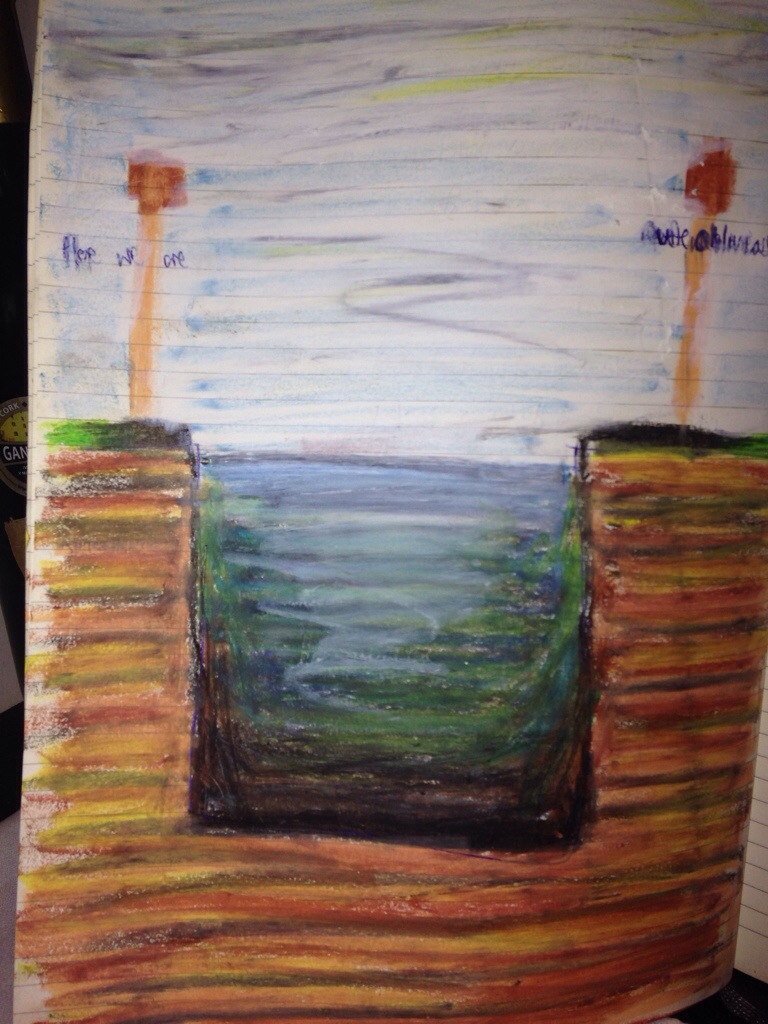
Here we are. Quite oblivious. is a very quick (and quite ugly) sketch that I did in an attempt to pare back my concept for Wait ’til it Settles to a 2-d form. This work shares resonances with my installation The Natural Course of Things, in that it’s about one’s consciousness (or lack thereof) of the various different layers of human existence, and the way in which nature can intervene to mask or reveal or dictate direction.
It’s 3rd Feb… and the water keeps on coming. All waterways are swollen to bursting, and dangerous, almost across the entire country, and more flood warnings have been issued today in Oxford. It’s incredible, just incredible. Figures show that parts of England have had their wettest January since records began more than 100 years ago.
Anyway, this is making me think about water in a different way. Ordinarily carefully preserved and measured, weather reports are showing polluted, overflowing excesses of water. Wildlife conservation is one of the things being blamed for water channels not having been sufficiently dredged over the past few years, and consequently unable to channel the quantities of water properly.
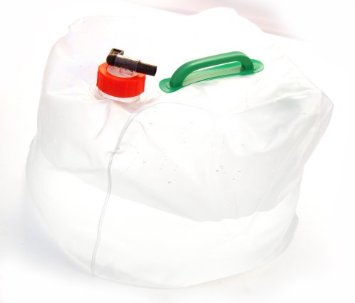
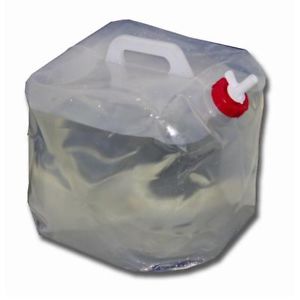
I’ve been thinking about water butts, and containers – vessels that we usually use to capture and contain ‘good’ water. My thoughts have turned to preserving this ‘bad’ water, and the various layers of history that it’s churning up in something that viewers might be able to relate to on a domestic level. I like the thought of the physicality of the selection below that I’ve found online, and that I’m considering using for my Wait ’til it Settles installation that’ll form part of the Inspired by the canal exhibition at the Jam Factory. I like the idea that, with some effort, they’re portable, so people might move them around in a restaurant environment, unsettling the waters. And I like the thought that, in the event of an emergency, one might wait til the muddy waters settle and then syphon the clean water off the top – ignoring the history, the old, settled murky water, and hoping for the best for the future.
Whatever containers are used in the end, I’d like them to be as transparent as possible so visitors can see what’s within (exposing the interior of a canal – laying it bare); and I’d like them to be mainly different in shape and form, just as the water within them will be taken from different parts of the Oxford canal.
On Saturday I attended a symposium entitled Nothing in Art organised by the Contemporary Arts Research Unit based out of Oxford Brookes University. The symposium was split into two parts, and I attended the earlier one (a pre-arranged dinner date prevented me from staying on), which saw CARU bring together artists and researchers from an array of disciplines and international backgrounds for a day of presentation, discussion and performance on contemporary art and music, theatre arts, anthropological study of art, and writing in art in the Green Rooms, Headington Hill Hall, Oxford.
After little by way of an introduction to the day from CARU’s event organiser, the day kicked off with a presentation by installation artist and sculptor Roger Perkins who introduced himself as the curator of History of The Greenham Holiday Resort, a museum telling the story of Greenham Common, which he proceeded to describe laboriously through a slideshow of images, an animated panorama of the interior of the museum building, and a video.
Perhaps naively, I was ignorant to the historical significance of Greenham Common, I wasn’t familiar with Roger Perkins as a curator or artist, but I did think that the post WWII Butlins style holiday camp concept sounded pretty plausible. What I was struggling to believe, however, was the extent to which Perkins was going to to describe this museum, the seriousness of his delivery, and his place in relation to this symposium. As my suspicion/curiosity heightened I turned to the leaflet (as I do when I find myself looking for guidance in museum/gallery environments) that he had handed out to members of the audience at the beginning of his presentation. The leaflet was in-keeping with the look of the museum – a bit shit in a dated 1980’s kind of over-loaded graphic, text-heavy way. Turning to the back page I noticed the ‘museum’ had been supported by the Esmee Fairbairn Foundation, ACE, Corn Exchange Newbury, Greenham Common Trust, and New Greenham Arts. The penny dropped. This wasn’t a bone-fide museum, this was an installation, and Roger Perkins is an artist presenting a project in character (I think).
We reached ‘Any Questions?’ and my suspicions were confirmed. An interesting project and presentation about truth and one’s willingness to accept without question. Perkins’ contribution to the symposium was entitled, What you see is what you’re told. His website states,
It turned out to be an apt and well-placed introduction to the day, and Roger Perkins is indeed a very good illusionist. The work had parallels with Ray Lee‘s fantastasic Ethometric Museum (which featured in an adapted form at the Musical Technologies: Old and New LiveFriday that I co-curated at the Ashmolean with the very brilliant, and very lovely Professor Eric Clarke, Heather Professor of Music at the University of Oxford – a career highlight for me!).
Next up was Oxford-based musician Malcolm Atkins, who I’d met previously through his involvement with Oxford Improvisers, his ‘set’ was billed as Why Morton Feldman is good for nothing. Again, my ignorance prevailed – who is Morton Feldman? Fortunately for me, Atkins had predicted such ignorance might exist in the audience and provided an introduction by way of a captivating performance of Morton Feldman’s compositions alongside Atkins’ own inspired by Feldman, and that of another composer also inspired by / responding to Feldman (I didn’t catch who the other composer was). Simultaneously the audience was drip fed contextual information about the life and work of Feldman on a projector, which was performative in itself as quotes and dialogues dripped onto the screen one letter at a time. We later learnt that this timing was more by accident than design as Atkins had ‘rehearsed’ his presentation using a PC, and the Mac he was using during the presentation/performance was set to a different speed. Regardless, there was a silent synergy that worked, somehow . The gaps in between (the greatness of nothing) were what the presentation was all about, after all – subconscious improvisation in action!
I have to confess that when I learned that Morton Feldman was famous for a six hour-long string quartet performance I wasn’t entirely sure how I might manage Atkins’ 35 minute presentation/performance. But it went by in a flash, and was probably the part of the day that I enjoyed the most, for all it was slightly disarming. In a 1982 lecture, Feldman noted: “Do we have anything in music for example that really wipes everything out? That just cleans everything away?”
Just as Feldman did so Atkins allowed nothingness in, and enabled the audience to take time out to concentrate on it, acknowledge its beauty and preciousness. It was a meditative experience, and I found myself fighting the urge to read the text that we were being presented with – fighting the urge to simply be empty.
For all it may sounds slightly ridiculous (Mum, Dad – if you read this!) I genuinely reached an altered state of being during that 35 mins, a state that would have been disquieting had it not been such a treat. It was a state that yoga has never enabled me to access – the closest I’ve ever got to is was probably in 2007 when I was amongst the first to sign up to watch the sun rise in James Turrell’s Deer Shelter Skyspace at Yorkshire Sculpture Park.
I also learnt that Feldman’s practice was influenced more by visual artists than it was by musicians, and that he spent more time going to museums and galleries, than he did going to recitals. I’m a Morton Feldman fan, and I’m incredibly grateful to Malcolm Atkins for the introduction!
This was followed by, And you said nothing, a very moving and captivating performative presentation by performance artist and theatre maker Stavroula Kounadea.
Stavroula Kounadea is a friend, not a close one, but someone I know, so I’m going to refer to her as Stav – as ‘Kounadea’ feels a bit weird. Anyway, Stav is one of those people whose eyes really look at you. You meet her and feel examined, not in an uncomfortable way, but a way that leaves you in absolutely no doubt that she is attentively, actively listening to you and logging your every word. She is someone that has a profound, perhaps innate or studied (I’m not sure which, I don’t know her that well), understanding of the art of communication. She talked about expressing the inexpressible through silence and the (Harold) Pinter Pause. And she demonstrated her mastery and understanding of the art of silence, or the everything of nothingness, as she swapped places with the audience and introduced us to an Audience with Stav as she stepped onto the ‘stage’ and exchanged our eyes for hers. She left the rapid-fire conversational delivery that I am more used to behind her and suspended her audience in the silences that say so much, leaving us hanging on her every poised, and precise word.
Whilst it would have been weird for her to break or to finish And you said nothing with questions, answers or observations (she simply left us in silence, with our own thoughts, of course), she describes her work on her website ,
“I am convinced now that what motivates me to create work that is live and performative is the magic of communicating with other people. The moment when you-the performer, the idea that until recently was just in your head, and all these people in the room actually coexist in reality. It’s almost surreal.
… I like creating work that is vibrant, fresh, witty, thought-provoking and entertaining. I like having fun when creating a piece of work.”
Filling the gaps that Stav left us suspended in, and leaving the audience to decipher an audio visual web, speaker number 4 was Austin Sherlaw-Johnson, who left me bemused… and a little confused. Read a bit about his practice on Nicholas Hedges’ website and see one of his performances at Audiograft 2013 here.
Social Anthropologist, Paola Esposito, introduced us to becoming nothing in butoh dance through her research topic, the anthropological significance of butoh, an avant-garde dance form that emerged in post war Japan, in contemporary Western society. As a concept, I think butoh dance is fascinating – heightening levels of consciousness, becoming physically and psychologically present in an environment, loosing one’s ‘self’ to such an extent that one begins to blend with one’s environment, a place of non-being, a transition from centric to non ego-centric perception.
You know when you want to reall
You know when you want to really like something, and feel that you’re perhaps just not giving something the attention it deserves!? Well, I found this description of butoh on the Sadler’s Wells theatre website, and I tapped butoh into YouTube. I’ve had a read, and a look, and a think… and I think it’s fascinating, and I get it, and I tried it under the instruction of Esposito… It’s just not for me – I didn’t find nothing there, I struggle to find nothing in yoga – horses for courses I guess, I’d be a busy girl if I was into everything I encounter!
Last but not least was the magnetically charming Veronica Cordova De La Rosa who has secured funding to create a bi-lingual (Spanish/English) on-line art journal for creative writing that is as relevant in her homeland, Mexico, as it is here in the UK where she is based. Vibrations is an online space, so effectively nothing – that intangible cyber space that we find ourselves relying on so heavily, for international creative reflection and exploration, and the intention is to ‘publish’ from the site three times per year – read more about it here.
I wasn’t entirely sure what I was going to take away from a symposium about Nothing in Art. A few days later I remain full of gratitude for being able to attend such a fascinating day, free-of-charge, that exposed me to the vast array of nothingness that exists, and the ways in which different artists magnify and manipulate it. A glorious day very well spent!
Looking back at the artists whose works caught my eye at the London Art Fair, I can only think that I was hankering after a bit of time in some wide open spaces. For me, there certainly is no place like home – the sights, sounds, smells of the North York Moors. The relative lack of people, and the abundance of natural activity that always leaves me with a clear head, and a healthy dose of heavy-handed perspective. I just love it. Anyway, after starting the year with five days back home, I can only think that my interest in the below listed artists had something to do with how much I enjoyed my time there, and how much I get out of the experience of being alone in wide, open spaces…
I hadn’t come across the work of Ruben Brulat (above) before. He’s a young French artist represented in the UK by Lamb Arts, and his large-scale photographic works are simply breathtaking. Such tremendous physicality dwarfed by all-encompassing natural landscapes… and more often than not it is actually him in the photo.
“Ruben Brulat’s approach has something romantic to it, romantic in the nineteenth century sense. His work ist that of a lonely, fanatic and mystic person, who’s thrown himself into a quest that confronts him to the limits and that opens the doors to a new apprehension of the world.”
At the other end of the scale I also really enjoyed Gill Rocca‘s miniatures – quietly dramatic experiments in scale.
This image does his fantastic wall-based sculpture no justice at all – check it out in person if you can.
Again, this image does very little justice to the work, but Andrew Mackenzie’s woodland scenes resonated with me, with their flashes of glaring neon, that I guess either act as warning beacons or lure the viewer in – they made me want to adventure inside them, and clamber through Mackenzie’s invisible yet tangible bracken beds in clarty clay-clad boots.
QUARRY EDGE 3, Oil on panel, 50 x 32 cm, 2010 by Andrew Mackenzie
Have a read of this interview that I found with Andrew Mackenzie here.
Heading to the opposite end of the country to North Yorks I found myself looking out to sea admiring the mystical, painterly work of Cornwall-based Gareth Edwards, and also the late Wilhelmina Barns-Graham and Karl Weshke, two great artists who also made their mark in/on Cornwall.




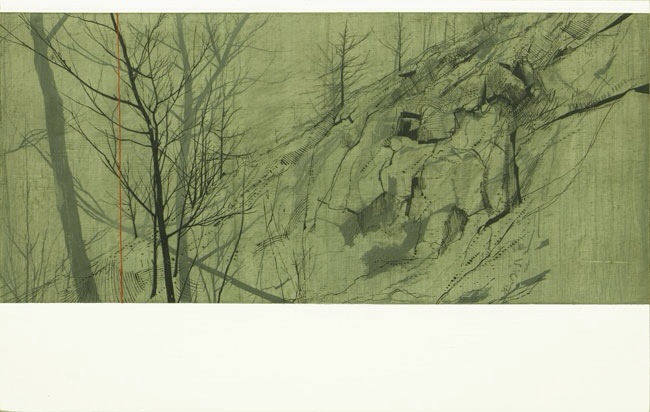
 Sarah Frances Mayhew