The space of literature

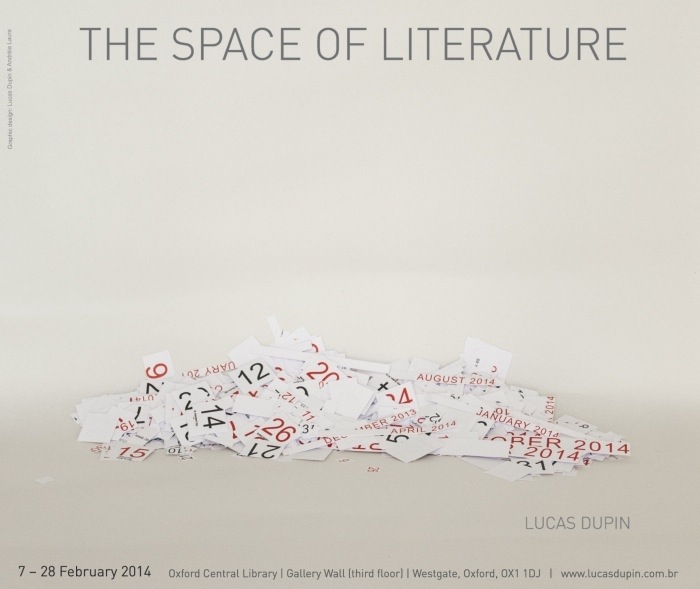
An exhibition by Lucas Dupin at Oxford Central Library
Continues until Friday 28 February 2014

20140225-084957.jpg

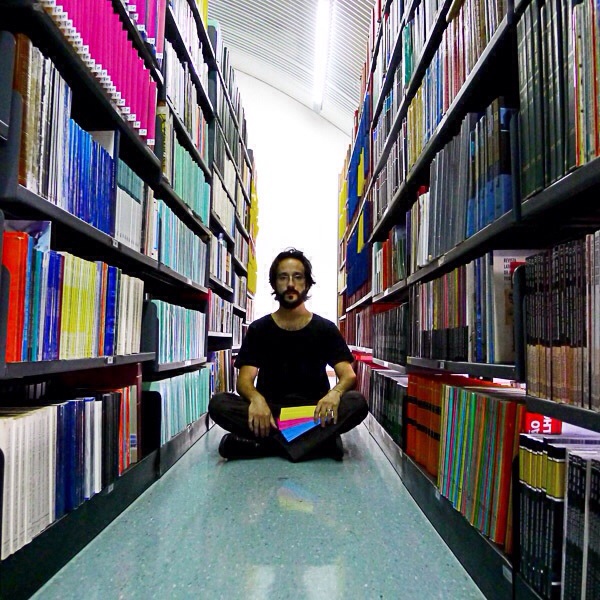
Lucas Dupin (b. 1985) is a Brazilian visual artist with an MA in Fine Art from the School of Fine Arts of the Federal University of Minas Gerais, Brazil, and a BFA from the same University.

Looking at the portfolio pages on Dupin’s website it’s clear to see that he’s an artist with an active interest in creating site-specific interventions in public spaces, both indoor and outdoor, in addition to exhibiting in traditional gallery spaces. Combine this penchant for public engagement with a deep-rooted interest in bookbinding and literature that runs alongside his practice, and it’s not surprising to find that this Brazilian artist has found himself in Oxford with an exhibition at the city’s central library.

20140225-084852.jpg

The space of literature comprises two new works, a wall-based installation and a series of watercolours. The work derives its title from a book by the French writer Maurice Blanchot. Despite its connection to the literary practice, Dupin’s artworks invites the viewer to enter into an experience, to explore an understanding of a place where time and space are absent. Dupin is interested in creating transportative experiences that enable the viewer to enter a space where one belongs to the imagination.

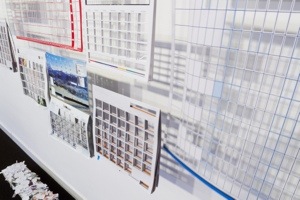
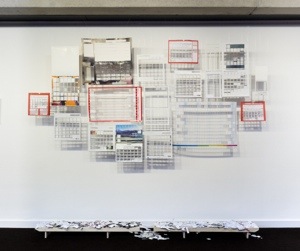
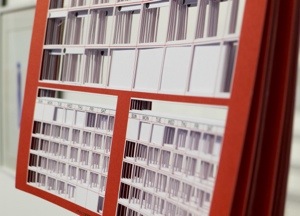
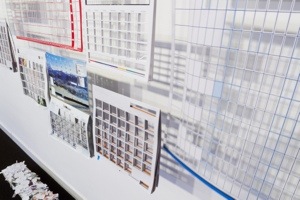
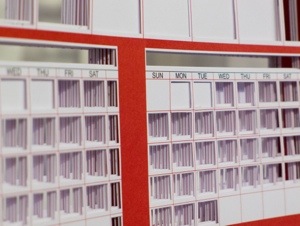
Deconstructing everyday objects, Dupin’s installation at Oxford Central Library comprises of a group of old calendars where all numeric or time references are cut out. What remains, hanging on the wall, is a geometrical patterns of grids, the left over spaces of the days plus the missing parts strewn across the floor.

The other other work is a set of displaced watercolours. The paintings evoke a space of strangeness where time and space seem to be suspended.

Lucas Dupin has worked with bookbinding since 2005, developing books, and teaching courses. In 2009 he won 2nd place in the ABER (Brazilian Association of Bookbinding and Restoration) contest in the amateur category with an exhibition at São Paulo Cultural Center. He also conducted a short internship at Atelier Reliures Houdart in Paris under the guidance of Ana Utsch in 2008.

Dupin’s work has been exhibited and featured in several solo and group exhibitions in Brazil, Canada and USA. Two years ago, he won the Energias da arte Prize, an important national award focused to young artists. As part of the prize he joined an artistic residency at The Banff Centre in Canada for two months. Other highlights in his curriculum are the prizes Forestry Interactions (2010) with an artistic residency at Terra UNA Eco Village and the competition and exhibition Olheiro da arte in Rio de Janeiro.

20140225-085909.jpg

20140225-085943.jpg

20140225-085500.jpg

20140225-085819.jpg

20140225-085841.jpg

20140225-085857.jpg

20140225-085924.jpg

Hannah Rickards and Roelof Louw at Modern Art Oxford

To enable me to fix my attention on any one of these symbols I was to imagine that I was looking at the colours as I might see them on a  moving picture screen.

What prompts someone to go to see an exhibition by an artist who’s unknown to them? Is it the reputation of the curator or the organisation(s) promoting / hosting the exhibition? Is it visual intrigue, perhaps an image, or a poster? Is it a layered decision… appetite whetted as one reads on, and then makes a decision? I guess it probably depends on the individual, and the power of the ‘prompting’ stimulus/stimuli.

I hadn’t heard of Hannah Rickards before, but I was intrigued as I’d met Paul Hobson who’d told me that this insertion into the programme was his doing, and he’d worked with her before. I was surprised by the relatively ‘last minute’ nature of this show by curatorial standards (knowing that so many exhibitions can be about three years in the making). So who is this Hannah Rickards, and why has Hobson so confidently nailed her colours to the Modern Art Oxford mast?

When I saw this ‘promo image’ of Rickards’ work, I was vaguely intrigued, but I wasn’t moved…
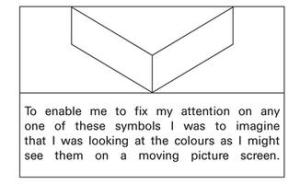
Hannah Rickards

Hannah Rickards

However, when I read on the Modern Art Oxford website that Hannah Rickards  is drawn to natural phenomena such as birdsong, thunder, mirage and the aurora borealis, which she examines through spatial works that take the form of moving image and sound I realised that there had to be more to this show than two dimensions, more than monochrome lines and text – there had to be colour, sound, movement, physicality of some description, there had to be leaps of imagination… I was intrigued, I was there, and I left sold.

It seems that Hobson and Rickards share common ground in their approach to life, both individuals with one eye on the bigger picture and all that it might entail whilst simultaneously delving deep into the microscopic detail of specific subjects. The Modern Art Oxford website explain that,
“Rickards’ scrupulous and investigative methodology involves the detailed deconstruction of her chosen subject. Breaking sounds or physiological occurrences down into minute parts for individual examination, her intense artistic gaze scrutinises each particle of information from a number of angles before reconstruction and eventual presentation.”

Bringing together Rickards’ important works to date in an interwoven configuration that spans all of the first floor galleries the exhibition is like taking a walk in the countryside in that it’s a personal exploration, the route isn’t dictated, but there are paths and physical markers to negotiate, and what you see and hear will entirely depend on what you’re open to seeing and hearing.

I didn’t find all of the work captivating, but I did find most of the work captivating, and the transporative experience of visiting the exhibition was, in itself, a truly fabulous one – meditative, reflective, a journey of heightened, transitory sensory experiences. If I could have thrown my arms around this show and licked it, I would have done… but it’s just too big; conceptually bursting out beyond the walls, floor and ceiling of the gallery spaces – it’s enormous, a truly immersive experience!

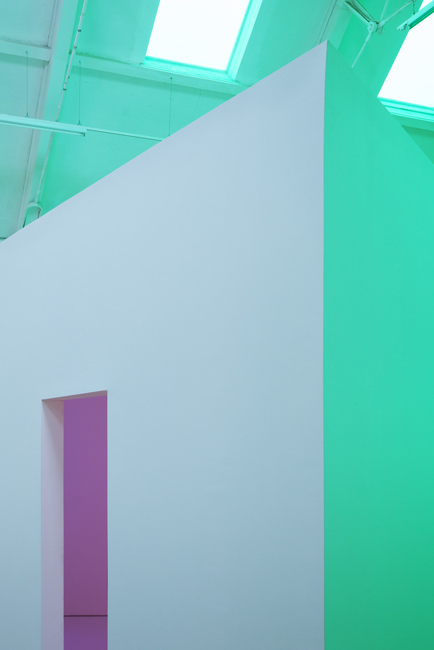
The light changes as one climbs up into the first floor galleries. Rickards has installed coloured gels in the space adding a heightened sense of dynamism to the light and visitor experience. I found myself questioning, doubting my own perceptions as my pace slowed, and I found myself moving cautiously around a room that was behaving in a way that I had never noticed before, yet it didn’t appear to have fallen pray to significant interventions, not to the scale by which I was being moved, anyway. Like land art, but inside.

Rickards comments on this phenomenon of articulating (or not) experience that she explores,
“Everything within this exhibition is to do with an uncertainty in language and how we might try to articulate a relationship to something beyond us in the world: musically, verbally, gesturally.”
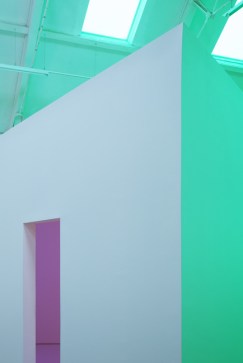
Hannah Rickards - installation shot

Hannah Rickards – installation shot

Her new work, Right here and then nothing anywhere else.  (2014), is a great example of this. Merely a descriptive tick chart. It reminded me of my English Literature teacher at school, Dr Foster. I recalled him discussing imagination and compartmentalisation with us. The way in which adults feel more comfortable (and therefore strive to) pigeon hole, whereas children haven’t developed a system to do this, and as it doesn’t really seem natural, as very few things in life fit neatly in their place, it seems like a ludicrous exercise, yet it’s one that we increasingly find ourselves being asked to conform to through life.

Putting their subjects into sharp focus, each of Rickards’ works breaks down the auditory, visual, or spatial relationships of its subject into minute parts for individual examination.  And this amused me, in a giddy way (giddy in the case of Thunder, a musical transcription and performance), the experience becomes so heightened, so intense that it’s thrilling; then one returns to the act of pigeon holing – how can one pigeon hole a sensory experience… or something!?

Visitors will encounter a piece of work with an incredibly long title, The sound I think it makes is, is that whispering sound, to me it sounds, it sounds almost, um, uh, what’s the word I’m thinking? Um, like historic, not historic, but, um, oh: a legend, it sounds like a legend, you know, when you think of a legend or something way back in the past you get that, that, it sounds like that to me, like this legend or somebody’s, this whispering sound: it’s a legend. The work is as much a three-dimensional object, a sculptural intervention and a light prism as it is a three-channel audio and video installation. As alluded to in the title, it can be virtually impossible to eloquently describe an experience sufficiently… it comes easier to poets, yet is the exact opposite to what lawyers do in a world where there is no room for nuance.

Yet, sometimes nuance is everything, you’ve just got to open yourself up to the intangible possibilities of it, and free yourself to wallow in it. This is an exhibition that deserves time, repeat visits in different weather conditions, repeats visits when you’re in a rush, and when you have all the time in the world. And isn’t that the wonderful thing about publicly funded exhibitions in the UK – the efforts of a team of radical gallery staff enable us to make these repeat visits FOR FREE!
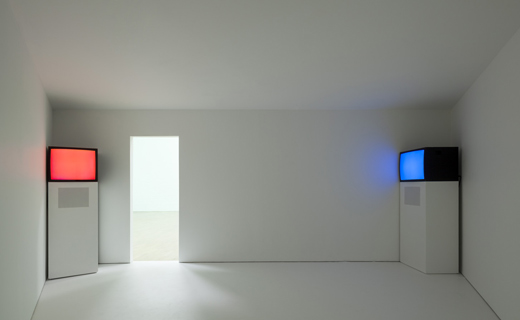
Hannah Rickards - installation shot

Hannah Rickards – installation shot

… and as Modern Art Oxford approaches its 50th anniversary on Pembroke Street, we are reminded that this is exactly what the gallery has been doing for half a century. Step back in time to 1969 when conceptual artist Roelof Louw created his seminal installation Location, a continuous black rubber band stretching horizontally around the four walls of the Upper Gallery at Modern Art Oxford.
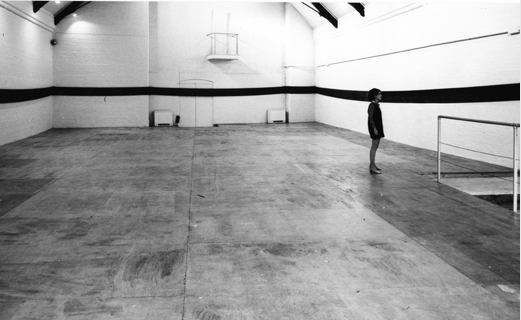
Location by Roelof Louw

Location by Roelof Louw

The exhibition opened to mixed reviews in ’69. Whilst conceptual art, performance art, and work of this interactive nature was becoming increasingly common-place in major cities in the Western world, it was quite a radical move for a regional art gallery, and apparently not everyone in Oxford was ready for it – hopefully this isn’t still the case!

Yet Louw’s critically acclaimed early work became renowned for its complex relationship between physical space, sculpture and viewer, as seen in Pyramid (Soul City), a carefully constructed pyramid of 6,000 oranges which gradually disappears as visitors help themselves to fruit (go on, take one of your five a day!) re-installed (with fresh oranges) in MAO’s Project Space.

This Roelof Louw archival exhibition was unearthed by PhD student, Hilary Floe, upon the revelation that Hannah Rickards’ work was going to be on show, and the two bodies of work chime perfectly. The Roelof Louw work forms part of a review of the history of exhibitions at Modern Art Oxford that will lead up to the 2016 anniversary.
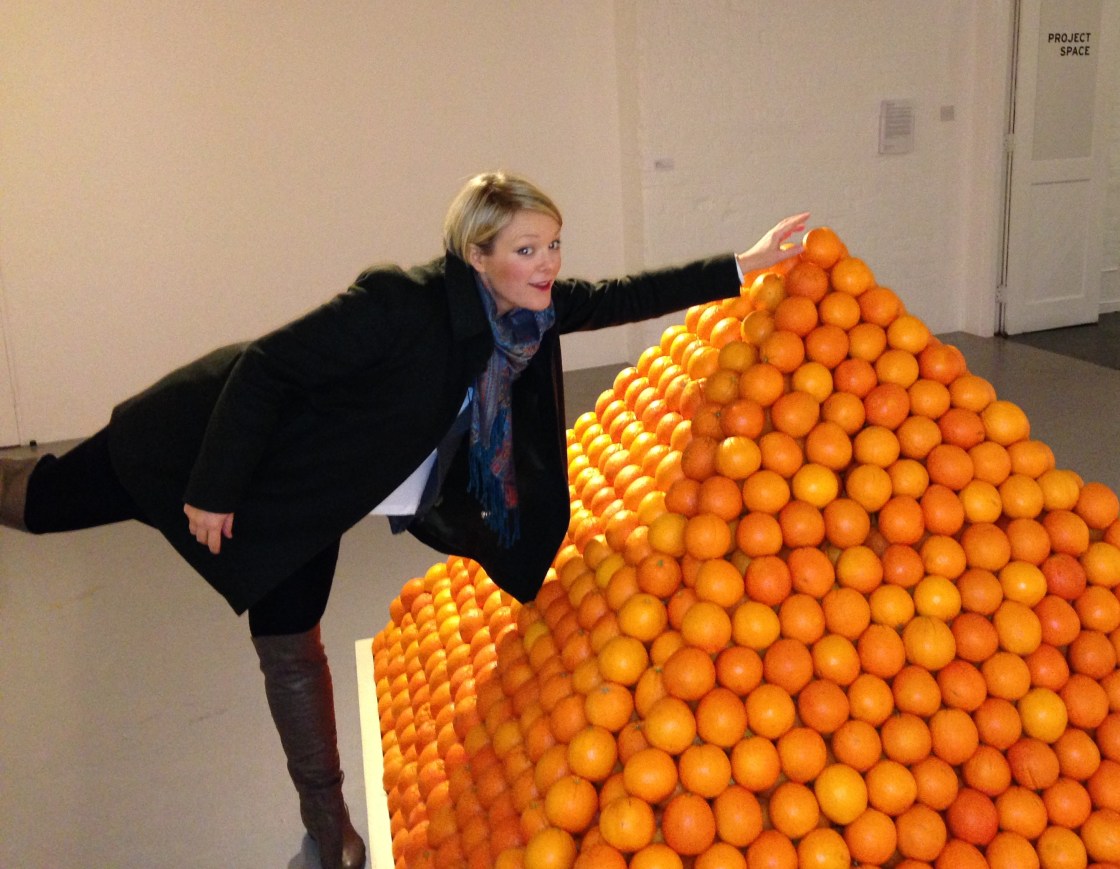
Me helping myself to one of my five a day

Me helping myself to one of my five a day

I went to see this exhibition on a cold, grey day feeling a bit miserable, and sorry for myself – I left elated, with a spring in my step, loving life, nature, art, and the fact that this gift is free.

The Hannah Rickards exhibition continues until 20 April 2014
The Roelof Louw exhibition continues until 6 April 2014
Voice Blindness

A really good friend of mine just called my mobile from a number I didn’t recognise. Said friend has been out of the country travelling for the last three months, and I wasn’t anticipating the call. He didn’t say who it was when he called in order to ‘surprise me’, but expecting me to recognise his voice, then jokingly (I hope) taking offense when I didn’t and asked him if it was someone else. The someone else I thought it might be was another old, male friend that I rarely hear from. Both friends are about the same age (mid to late 30s), both friends are smokers, both friends are male, both friends are dear to me. One friend is originally from near Glasgow, the other friend is originally from near Middlesbrough, but both friends have been living in the Midlands/South East for most of their adult lives. In short, I knew that I knew the voice, I just couldn’t pin down whose voice it was, not even after he told me his name (I appreciate that this sounds as though I’m a really bad friend, but I’ve known this guy for years and love him like a brother – that’s why it’s flummoxed me!)… and it left me wondering if I knew that I knew it because I recognised it, or if I just thought that I must know it because of the familiar way that I was being spoken to!?

This wasn’t the first time that I haven’t recognised someone’s voice over the phone. I’m a busy person, I get a lot of calls, I’m not always (in fact rarely) thinking about the caller when they call, so I’ve previously stamped my feet and thought it rude, arrogant and presumptuous that people should expect me to know who they are without introducing themselves when they call.

However, this train of thought made me think that perhaps it’s not their problem… it could be mine. Do other people instantly recognise voices over the phone, I wondered? Having quite an acute sense of smell, being an artist, and naturally analytical I find that I have quite hyper-real experiences from time to time, when I really indulge myself in a sensory experience, and I love it.

Though it’s commonly recognised that animals use their senses in different ways to humans in a survival of the fittest in their given environment, evolutionary fashion – moles are blind (or as good as), but they have an incredibly well-developed sense of touch, birds of prey have amazing eye-sight (my Dad’s nickname for me as a child was Hawk Eye) but a poor sense of smell, whilst dogs tend to have a great sense of smell, but have less well-developed hearing etc. My other half is always bemoaning the sound levels that I set the TV at, I claim that I enjoy the cinematic, immersive experience… but is it more that we’re wired in a different way. Is his hearing more finely tuned than mine? Is hearing my weak sense? Well, I don’t think it is, it’s not that I don’t hear things, I do, and I love listening to music. However, I wonder if some people, myself included, might have faulty / lesser developed sonic recognition synapses?

**Cue some Googling**

A paper in the journal Science describes this difficulty in differentiating between voices as voice blindness and goes on to describe how Impaired phonological processing is characteristic of dyslexia and thought to be a basis for difficulty in learning to read. This figures, and from a personal perspective, whilst I have no problems reading and writing now, I did when I was a child (my spelling was atrocious). This would also explain the frustration of a man in a supermarket recently whose first language wasn’t English and hadn’t a clue what I was asking for when I inquired as to where the nuts are (he recognised nuts in a southern accent ‘na(soft a)ts’ but he didn’t recognise my guttural, vowelly ‘nUts’ – getting nowhere I temporarily cast off my upbringing, went received pronunciation on him… and left the supermarket with a packet of peanuts. What I’m getting at, is that there’s no denying that, depending on accent and inflection, the same words can sound incredibly different (take the word garage for example), and English is a difficult language with so many phonetic tricks at play between the written and spoken word… but I digress.

What I was left wondering after this phone conversation is if I over-compensate for my poor phoneme sound library by looking and/or smelling harder; and if, in doing this, I am not exercising my phoneme muscle sufficiently!?

Interestingly, my Mum has a very distinctive voice. Having grown up with it, I’m not entirely sure what it is about it that makes it so distinctly Alma, it’s just ‘Mum’s voice’ but other people tell me, and her, how distinctive it is. To a lesser extent, I too have been told that I have a very distinctive voice, and an extremely distinctive laugh. Mum and I are both frequently told that our voices can be heard above the hubbub of a crowded room. Again, I’m pretty oblivious to this fact, and I think she is too, we just talk…. but we don’t sound particularly similar (I don’t think!). Does my brother have a distinctive voice? Not particularly I don’t think. He has an irritating (in my opinion) habit of morphing his voice according to who he’s talking to – vocal replication – I’m sure he never has any problems finding nuts in a supermarket! Thinking about it now, I wonder what kind of a weird voice my unborn baby might have when it pops out in a couple of months time, or if I’ll even recognise it!

Mum’s been told that she’s tone deaf, I used to tell her that it was her embarrassing singing in church that made me into an atheist (this isn’t the reason – I was just a mean child!), people have since told her that there is no such thing as being tone deaf. Well, it sounds as though there might be, and I wonder if it’s inherited!? There’s a few interesting words on this subject on the BBC World Service website 14minutes 17seconds into one of their Science in Action programmes – details below:

“Dyslexia is usually considered to be a reading disorder, when the brain does not recognise some symbols properly. It can lead to problems with understanding the written world. Now, brand new research in Science magazine shows that dyslexics may also have problems identifying voices. The BBC’s Jennifer Carpenter tells us about the findings.”

In short, it would seem that very little is known about voice blindness or phonagnosia (as it was formally called)… but I reckon I might have it, not badly, but a little bit – at least, that’s what I’m going tell my friend who called earlier!

Windows of escape framed by hospital life

I sat next to a man at a symposium the weekend before last who explained that his partner organises exhibitions at the local hospital, the John Radcliffe. Oxford’s a small place, and it immediately clicked that his partner must be Gabriele Dangel from Notfamousyet – I’ve seen stuff that she’s curated before, and I’ve rated it, though I’ve never been up to the hospital to see anything that she’s programmed there.

Contemporary art in hospitals is nothing new these days, but meeting this guy, and thinking about what Gabriele is doing set me thinking about the importance of it, and the need to signpost it well, and take it seriously within the holistic hospital environment. By that, I mean that I found myself (slightly lost, geographically and emotionally) in a hospital chapel in my ‘hour of need’ a couple of years ago… but I’d have been much more appropriately placed in a gallery space.

Anyway, last week I received an email about another exhibition by Claudia Figueiredo and Jonathan Moss this one on South Street at The Churchill Hospital, Oxford. The exhibition, Windows of escape framed by hospital life, continues until Saturday 8th March 2014. I’m probably going to find myself in hospital as a patient in a couple of months time, and as such, just wanted to say thank you to those that exhibit and coordinate quality contemporary art in hospitals. I reckon I’m soon going to really appreciate something that, as a healthy member of the public, I’ve previously overlooked.

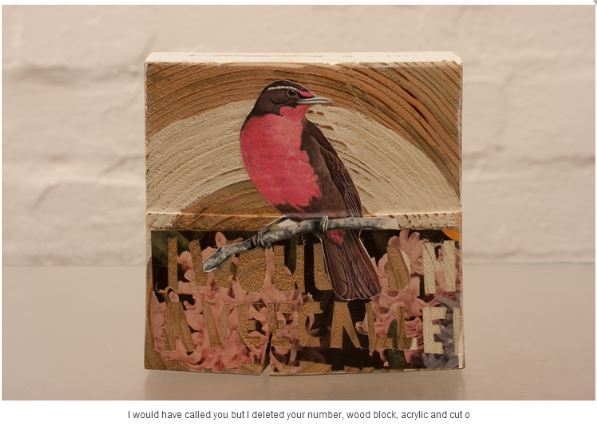
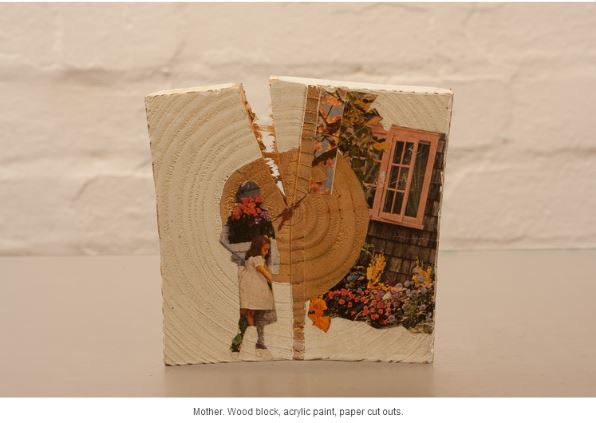
Claudia Figueiredo Claudia - Mother

The history of the Oxford Canal

The below information has been swiped from the hugely informative Canal River Trust website where you’ll find a whole host of other interesting canally stuff including competitions and tips on days out aboard a canal boat.

The Oxford Canal is amongst the earliest of cuts in the Canal Age. It was initially designed by James Brindley, succeeded by Samuel Simcock and Robert Whitworth after Brindley’s untimely death in 1772 at the age of 56.

It was opened in sections between 1774 and 1790 with the purpose of bringing coal from the Coventry coalfields to Oxford and the River Thames. The canal formed part of Brindley’s grand plan for a waterway ‘cross’ linking the rivers Thames, Mersey, Trent and Severn.

The Oxford Canal provided a direct link with London via the Thames, and for several years was hugely profitable. The arrival of the Grand Junction Canal, linking Braunston to London and later becoming the backbone of the Grand Union Canal, finally broke its stranglehold and effectively bypassed the southern half of the Oxford Canal.

Nonetheless, it brought more traffic to the northern section, which soon required upgrading. The Oxford Canal was originally built to the contour method favoured by Brindley, which not only meant that the level remained fairly constant, but that the canal could call at many villages and wharves along the route. The drawback to this approach was lengthy transit times.

Boating at Braunston

In the 1830s, Marc Brunel and William Cubitt made the most of developments in engineering to straighten Brindley’s original line. Several of the resulting ‘loops’, where the new line bisected the old, can still be seen: some have found use as tranquil moorings. Other improvements included the duplication of locks at Hillmorton, and widening on the stretch between Napton and Braunston, where the canal shares its route with the modern-day Grand Union.

But the southern section between Napton and Oxford remains remarkably unspoilt and offers an evocative insight into canal life as it would have been two centuries ago. Trade began to seriously decline on the Oxford after World War II, but commerce continued well into the 1960s.

Tooley’s Boatyard, in Banbury, is famous as the spot from where canal pioneer Tom Rolt set out on his 1930s journey around the waterways. His travels in Cressy were immortalised in the book Narrow Boat, which directly led to the formation of the Inland Waterways Association and the campaign to save the waterways. The boatyard has recently been reborn as the centrepiece of the Castle Quays shopping development.

The historic Oxford terminus of the canal is long lost, sold to Nuffield College and redeveloped as a public car park. However, support is growing for proposals to reinstate it as the heart of a new cultural quarter for the city.

…………

What I need to do now, is figure out which points along the canal I’m going to collect water from. I’d like to have about 20 points to choose from, some of them recently renovated, others as old as they get. Some fast-flowing, others as stagnant as possible – please email me with any suggestions (sarah@sarahmayhewcraddock.com)