Happenings throughout History along The Oxford Canal

So, I spent a day trawling through The Oxford Times and Oxford Mail archives looking for stories and tales to do with The Oxford Canal, and I owe Chris McDowell (resident archivist and man everyone wants on their team in a pub quiz) a great big thank-you for all of his help and patience with me – he’s a brilliant man!

Anyway, below is a list of some of the places where interesting ‘happenings’ have taken place along the canal as it flows towards, and passes through Oxford city centre – there were plenty more stories littering other parts of this 78-mile-long stretch of waterway, but as this exhibition is taking place in Oxford I’ve decided to keep it local. I’ve also made the decision not to include the dates of the occurrences, or details of the occurrences that would enable people to date them, as the point of Wait ’til it Settles is that there’s more to this canal than meets the eye. History has made the canal what it is today, the good, the bad and the ugly – the underlying stories that have carved out its meandering shape, its physicality, its locks, its railings, its paths, its warning signs, its lifebuoys, its beauty spots, its cottages, its cottaging!

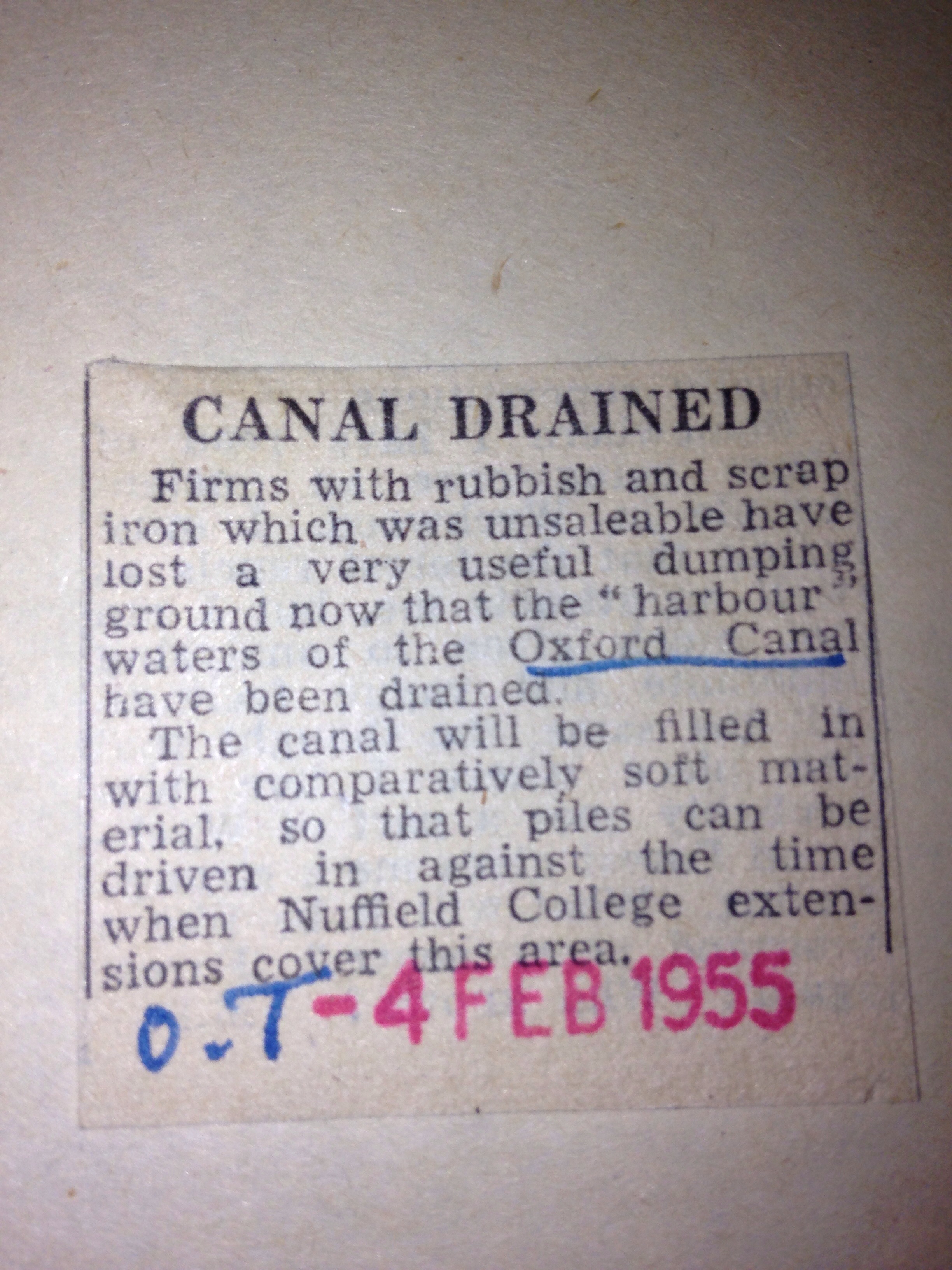
  • Drained – Canal Basin (under Worcester Street Car Park)
  • Body found – Isis Lock (or Louse Lock)
  • Dangerous condition – Wolvercote Lock
  • Girl attacked – near St Barnabas Church, Jericho
  • Natural beauty – Wolvercote (between Dukes Cut and Thrupp)
  • Soliciting – Canal Towpath (near Hythe Bridge Street)
  • Sewerage spill – Downstream from Kidlington
  • Pollution killing fish – Hythe Bridge Street
  • Dredging – Between Frenchay Road and Isis Lock (or Louse Lock)
  • Dynamite sticks found floating – Aynho
  • Birth on a boat – Swinford Bridge
  • Litter – Upper Fisher Row
  • Natural beauty – Shipton Weir Lock
  • Fatal accident – Shipton-on-Cherwell
  • Oil slick – Jericho
  • Commercial traffic – Enslow Wharf
  • Towpath charges – Godstow

Water from some of these locations will be displayed at The Jam Factory from 1st to 28th April 2014 as part of the Inspired the Canal exhibition.

In other news, here’s a list of interesting Oxford-canal based resources that I’ve happened across online in the last week:


20140329-084316.jpg

Resources – The Oxford Canal

A useful list of links and info from Oxford-based historian, canal dweller and Mr www.oxfordwaterwalks.co.uk, Mark Davies…

“Dear Sarah,

I am responding to the message you left with JLHT, in respect of source information about the Oxford Canal. Sadly, there is no handy map – it’s something we pondered as part of the Project, but have had to put off until later this year – but you will find maps in the Nicholson’s Cruising Guide to the whole canal, for instance.

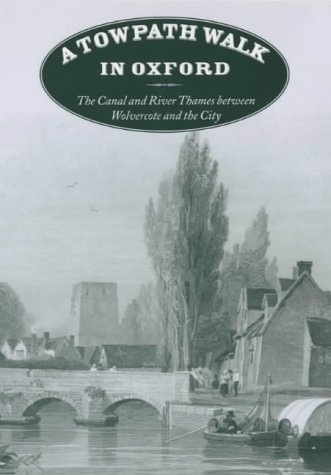
As for information, I imagine that you will find my own book A Towpath Walk in Oxford helpful, as too The Oxford Canal by Hugh Compton. Both are available from the library, along with other titles that you may find helpful.

You might like to note that I am giving a talk at the Jam Factory on April 27th, incidentally:

The Oxford Canal: an artistic history

2.30pm, Sunday 27 April 2014, The Jam Factory, 27 Park End Street.
Free illustrated talk, one hour including questions.

From the industrial origins of the Oxford Canal to its modern leisure-based revival, artists have have provided an invaluable supplement to the historical record of Oxford’s resilient ‘half-town, half-country’ waterway. As part of the Oxford Canal Heritage Project, Oxford local historian Mark Davies will expand on the varied themes revealed in two centuries of paintings, drawings, and engravings, including traditional narrowboat decoration and artwork related to more recent campaigns to save the Canal and its facilities from closure.

Mark”

20140319-084829.jpg

I’m also off to Oxfordshire Newsquest HQ later this week to scour their archives for Oxford Canal based stories – looking forward to that!

More info about the Inspired by the Canal exhibition here

Hyper-real Landscapes

I was just discussing how invisible my large pregnancy bump appears to be to the vast majority of the population. This led to a conversation about whether modern day society is made up of people lacking in good manners (I sound so old), or if modern day society is made up of people so consumed by themselves and their man-made distractions, namely their phones (she says, writing this from a smart phone), that they are simply blind to the world around them.

Either way, it was interesting to consider the thick blanket of fog that covered pretty much the entire UK this morning. A friend took this fabulous photo looking east off London Bridge this morning…

20140313-172710.jpg

I love that, in such a dense urban environment, so much ‘everything’ is shrouded by nature presenting us with so much ‘nothing’.

It made me consider hyper-real environments, what we need to do to make that modern day society sit up and smell the coffee; that is, become alert to the wonders that surround them on a daily basis. Then another friend posted this image on Facebook…

20140313-173151.jpg

Perhaps we’re all thinking the same thing!?

Voice Blindness

A really good friend of mine just called my mobile from a number I didn’t recognise. Said friend has been out of the country travelling for the last three months, and I wasn’t anticipating the call. He didn’t say who it was when he called in order to ‘surprise me’, but expecting me to recognise his voice, then jokingly (I hope) taking offense when I didn’t and asked him if it was someone else. The someone else I thought it might be was another old, male friend that I rarely hear from. Both friends are about the same age (mid to late 30s), both friends are smokers, both friends are male, both friends are dear to me. One friend is originally from near Glasgow, the other friend is originally from near Middlesbrough, but both friends have been living in the Midlands/South East for most of their adult lives. In short, I knew that I knew the voice, I just couldn’t pin down whose voice it was, not even after he told me his name (I appreciate that this sounds as though I’m a really bad friend, but I’ve known this guy for years and love him like a brother – that’s why it’s flummoxed me!)… and it left me wondering if I knew that I knew it because I recognised it, or if I just thought that I must know it because of the familiar way that I was being spoken to!?

This wasn’t the first time that I haven’t recognised someone’s voice over the phone. I’m a busy person, I get a lot of calls, I’m not always (in fact rarely) thinking about the caller when they call, so I’ve previously stamped my feet and thought it rude, arrogant and presumptuous that people should expect me to know who they are without introducing themselves when they call.

However, this train of thought made me think that perhaps it’s not their problem… it could be mine. Do other people instantly recognise voices over the phone, I wondered? Having quite an acute sense of smell, being an artist, and naturally analytical I find that I have quite hyper-real experiences from time to time, when I really indulge myself in a sensory experience, and I love it.

Though it’s commonly recognised that animals use their senses in different ways to humans in a survival of the fittest in their given environment, evolutionary fashion – moles are blind (or as good as), but they have an incredibly well-developed sense of touch, birds of prey have amazing eye-sight (my Dad’s nickname for me as a child was Hawk Eye) but a poor sense of smell, whilst dogs tend to have a great sense of smell, but have less well-developed hearing etc. My other half is always bemoaning the sound levels that I set the TV at, I claim that I enjoy the cinematic, immersive experience… but is it more that we’re wired in a different way. Is his hearing more finely tuned than mine? Is hearing my weak sense? Well, I don’t think it is, it’s not that I don’t hear things, I do, and I love listening to music. However, I wonder if some people, myself included, might have faulty / lesser developed sonic recognition synapses?

**Cue some Googling**

A paper in the journal Science describes this difficulty in differentiating between voices as voice blindness and goes on to describe how Impaired phonological processing is characteristic of dyslexia and thought to be a basis for difficulty in learning to read. This figures, and from a personal perspective, whilst I have no problems reading and writing now, I did when I was a child (my spelling was atrocious). This would also explain the frustration of a man in a supermarket recently whose first language wasn’t English and hadn’t a clue what I was asking for when I inquired as to where the nuts are (he recognised nuts in a southern accent ‘na(soft a)ts’ but he didn’t recognise my guttural, vowelly ‘nUts’ – getting nowhere I temporarily cast off my upbringing, went received pronunciation on him… and left the supermarket with a packet of peanuts. What I’m getting at, is that there’s no denying that, depending on accent and inflection, the same words can sound incredibly different (take the word garage for example), and English is a difficult language with so many phonetic tricks at play between the written and spoken word… but I digress.

What I was left wondering after this phone conversation is if I over-compensate for my poor phoneme sound library by looking and/or smelling harder; and if, in doing this, I am not exercising my phoneme muscle sufficiently!?

Interestingly, my Mum has a very distinctive voice. Having grown up with it, I’m not entirely sure what it is about it that makes it so distinctly Alma, it’s just ‘Mum’s voice’ but other people tell me, and her, how distinctive it is. To a lesser extent, I too have been told that I have a very distinctive voice, and an extremely distinctive laugh. Mum and I are both frequently told that our voices can be heard above the hubbub of a crowded room. Again, I’m pretty oblivious to this fact, and I think she is too, we just talk…. but we don’t sound particularly similar (I don’t think!). Does my brother have a distinctive voice? Not particularly I don’t think. He has an irritating (in my opinion) habit of morphing his voice according to who he’s talking to – vocal replication – I’m sure he never has any problems finding nuts in a supermarket! Thinking about it now, I wonder what kind of a weird voice my unborn baby might have when it pops out in a couple of months time, or if I’ll even recognise it!

Mum’s been told that she’s tone deaf, I used to tell her that it was her embarrassing singing in church that made me into an atheist (this isn’t the reason – I was just a mean child!), people have since told her that there is no such thing as being tone deaf. Well, it sounds as though there might be, and I wonder if it’s inherited!? There’s a few interesting words on this subject on the BBC World Service website 14minutes 17seconds into one of their Science in Action programmes – details below:

“Dyslexia is usually considered to be a reading disorder, when the brain does not recognise some symbols properly. It can lead to problems with understanding the written world. Now, brand new research in Science magazine shows that dyslexics may also have problems identifying voices. The BBC’s Jennifer Carpenter tells us about the findings.”

In short, it would seem that very little is known about voice blindness or phonagnosia (as it was formally called)… but I reckon I might have it, not badly, but a little bit – at least, that’s what I’m going tell my friend who called earlier!
The history of the Oxford Canal

The below information has been swiped from the hugely informative Canal River Trust website where you’ll find a whole host of other interesting canally stuff including competitions and tips on days out aboard a canal boat.

The Oxford Canal is amongst the earliest of cuts in the Canal Age. It was initially designed by James Brindley, succeeded by Samuel Simcock and Robert Whitworth after Brindley’s untimely death in 1772 at the age of 56.

It was opened in sections between 1774 and 1790 with the purpose of bringing coal from the Coventry coalfields to Oxford and the River Thames. The canal formed part of Brindley’s grand plan for a waterway ‘cross’ linking the rivers Thames, Mersey, Trent and Severn.

The Oxford Canal provided a direct link with London via the Thames, and for several years was hugely profitable. The arrival of the Grand Junction Canal, linking Braunston to London and later becoming the backbone of the Grand Union Canal, finally broke its stranglehold and effectively bypassed the southern half of the Oxford Canal.

Nonetheless, it brought more traffic to the northern section, which soon required upgrading. The Oxford Canal was originally built to the contour method favoured by Brindley, which not only meant that the level remained fairly constant, but that the canal could call at many villages and wharves along the route. The drawback to this approach was lengthy transit times.

Boating at Braunston

In the 1830s, Marc Brunel and William Cubitt made the most of developments in engineering to straighten Brindley’s original line. Several of the resulting ‘loops’, where the new line bisected the old, can still be seen: some have found use as tranquil moorings. Other improvements included the duplication of locks at Hillmorton, and widening on the stretch between Napton and Braunston, where the canal shares its route with the modern-day Grand Union.

But the southern section between Napton and Oxford remains remarkably unspoilt and offers an evocative insight into canal life as it would have been two centuries ago. Trade began to seriously decline on the Oxford after World War II, but commerce continued well into the 1960s.

Tooley’s Boatyard, in Banbury, is famous as the spot from where canal pioneer Tom Rolt set out on his 1930s journey around the waterways. His travels in Cressy were immortalised in the book Narrow Boat, which directly led to the formation of the Inland Waterways Association and the campaign to save the waterways. The boatyard has recently been reborn as the centrepiece of the Castle Quays shopping development.

The historic Oxford terminus of the canal is long lost, sold to Nuffield College and redeveloped as a public car park. However, support is growing for proposals to reinstate it as the heart of a new cultural quarter for the city.

…………

What I need to do now, is figure out which points along the canal I’m going to collect water from. I’d like to have about 20 points to choose from, some of them recently renovated, others as old as they get. Some fast-flowing, others as stagnant as possible – please email me with any suggestions (sarah@sarahmayhewcraddock.com)