Smellscapes

I was born with a pretty acute sense of smell, and have long-since been interested (on a novice level) in the relationship between smell and memory, and the way in which interior designers use smell to influence people (think piping the smell of fresh bread into supermarkets) – it’s fascinating! So I was quite excited to hear about Victoria Henshaw‘s new book, Urban Smellscapes whilst listening to Radio 4 yesterday morning. She was contributing to a programme about Landscape and the Community, specifically about what we lose when we sterilise our environment.

The radio programme made me think back to my earliest memories of smell and the way that smells have the ability to transport me to another time and space… the smell of my freshly washed Grandad and his lashings of aftershave as he called in to our house on the way to the pub when I was a little girl… the smell of my other Grandad’s pipe tobacco mixed with the baking smells from Grandma’s kitchen and the cold air trapped within the thick sandstone walls of their farmhouse. The smell of stepping  back in time into a world that I didn’t know on the train at the Yorvik Centre in York – an imagined smell.

The idea of transportative imagined smells reminded me of a brilliant exhibition, If Ever There Was, about extinct and impossible smells that I saw at the Reg Vardy Gallery, University of Sunderland a few years ago (2008, I think). The exhibition drew upon the efforts of perfumers, chemists, botanists and a Nasa scientist.
“What we have created here is a world first, a scientific flight of fancy made up of exotic and strange scents,” says Robert Blackson of the University of Sunderland, mastermind behind the endeavour.

In his book of essays entitled Late Night Thoughts on Listening to Mahler’s Ninth Symphony the physician Lewis Thomas wrote, “The act of smelling something, anything, is remarkably like the act of thinking itself.” I’m inclined to agree, and imagine that Victoria Henshaw is too!

Here’s a link to an interesting blog entry about the exhibition, and a review of the exhibition by Roger Highfield, The Telegraph’s Science Editor. And here’s a  link to an interesting talk about Designing Multisensory exhibitions that took place at the Met.
Sensory Maps

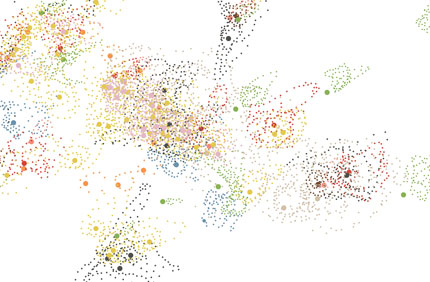
Whilst reflecting upon the work of Victoria Henshaw I have just stumbled across a website about the research, analysis & design of Sensory Maps by Kate McLean www.sensorymaps.com. McLean created the below map with the help of Michael Meighan (author of “Glasgow Smells”) as well as Glasgow-based commuters, residents, workers, tourists, and Glasgow City council. The work went on display at the Glasgow Science Center in September 2012.

©Kate McLean Design 2012

McLean makes really interesting cross-sensory, boundry-less, scale-defying work about the curiosity of landscape, and those that might take an interested in it for various different reasons. She described a recent mapping experience as,

“…a perfect example of exformation; “understanding how little we know.” (Hara, K 2009 “Designing Design”) Exformation leads us to curiosity. Curiosity leads us to creativity. Creativity leads us to knowledge. “To know something is to impregnate the senses with an inspirational, vital, exciting experience.” (Ibid.) Knowledge excites us.

It is time to stop trading information and start using exformation to question what we know, to raise more questions than answers. This is the epistemology driving future smellmapping projects.”

I like Kate McLean – let’s embrace exformation (and remember how many words the Eskimos have to describe snow – I write this with tongue in cheek to make a point about relevance and communication).

Layers of light and water

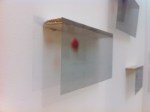
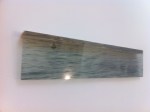
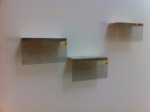
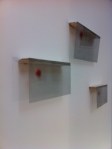
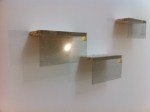
Images taken in my studio of some wall-mounted works I’m playing around with. I like the way the light passes through the acetate casting shadows on the wall behind it, and that this shadow changes as the position of the sun moves. A constant reminder of our place in the world and the notion that greater powers beyond our control are at work. The photos were taken in Annecy, France.

Experiments for large-scale public-space art installations

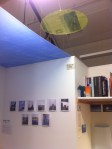
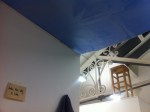
Look, the Sky is Blue, It Never Stops Shining, and Let There be Light are ideas for a series of large-scale public-space installations for urban spaces that loom over the viewer given a physical sense of wonder that can be moved around, marveled at, and explored. The intention of the series of sculptures is to reconnect the viewer with nature and their environment by reminding them of the elements, and in an attempt to encourage people to take time out to think, and physically lose themselves in perspective.