Sketches for a new installation idea about the precious and precarious nature of life…
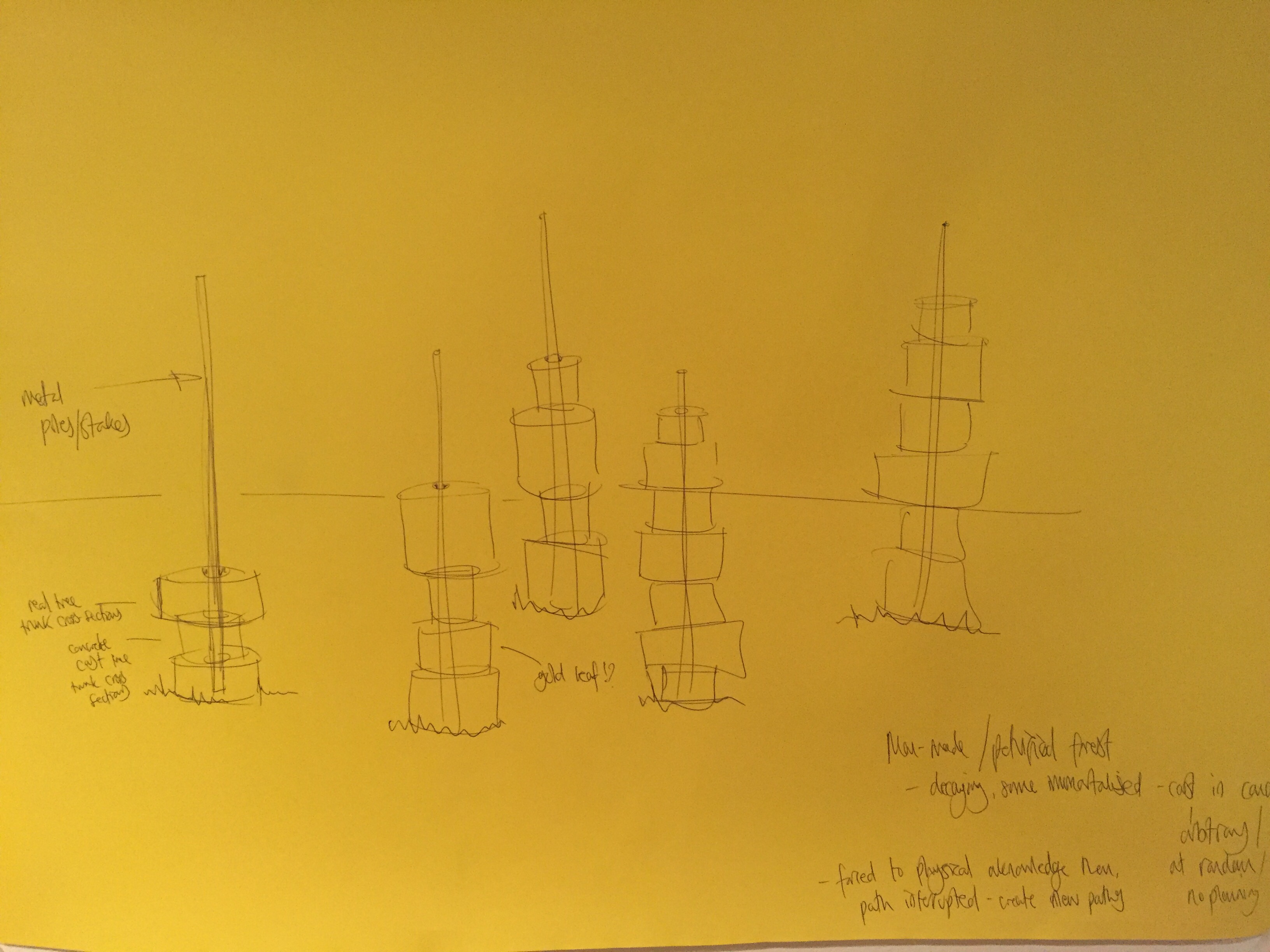

Sketches for a new installation idea about the precious and precarious nature of life…
I’ve just been admiring this beautiful installation, Molar, created in 2016 by Chinese-American artist Jennifer Wen Ma.
Molar is a new site-specific commission created for A Beautiful Disorder, a group exhibition of 16 Chinese sculptors at the Cass Sculpture Foundation. Many of Wen Ma’s works take landscape or nature as their subject matter; this installation offers a place of reflection in a disintegrating utopia, where beauty and destruction cohabit, and inspiration can be drawn from the diseased as well as the prosperous.
Watch an interview of Wen Ma in conversation with Studio International talking about Molar and her wider practice, now split between Beijing and New York.
The below text has been lifted directly from her website.
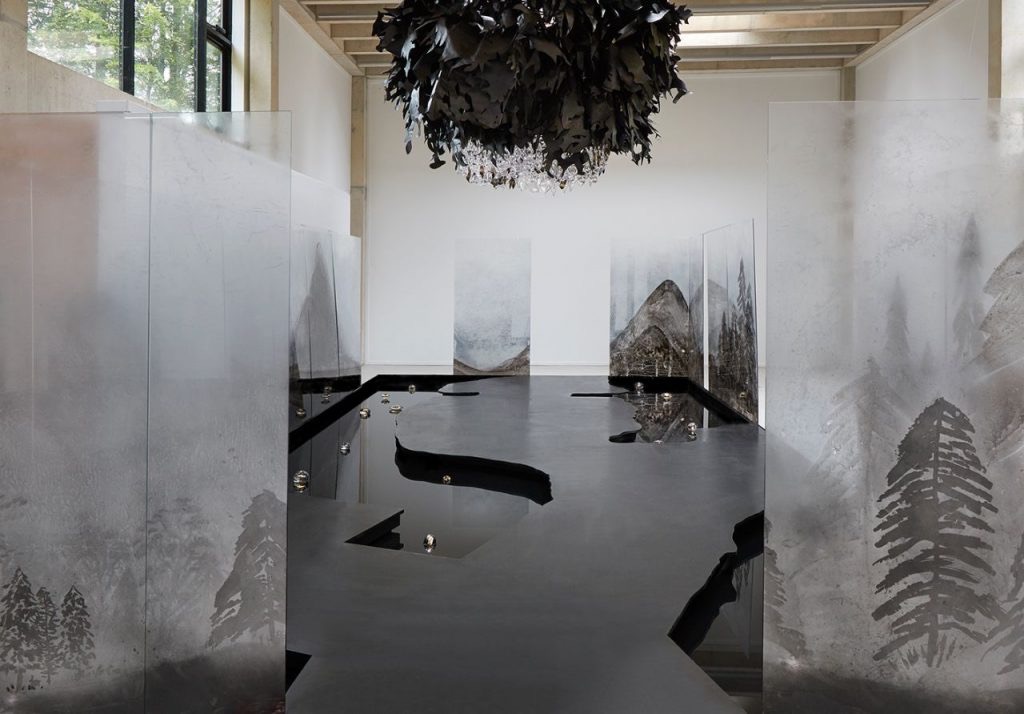
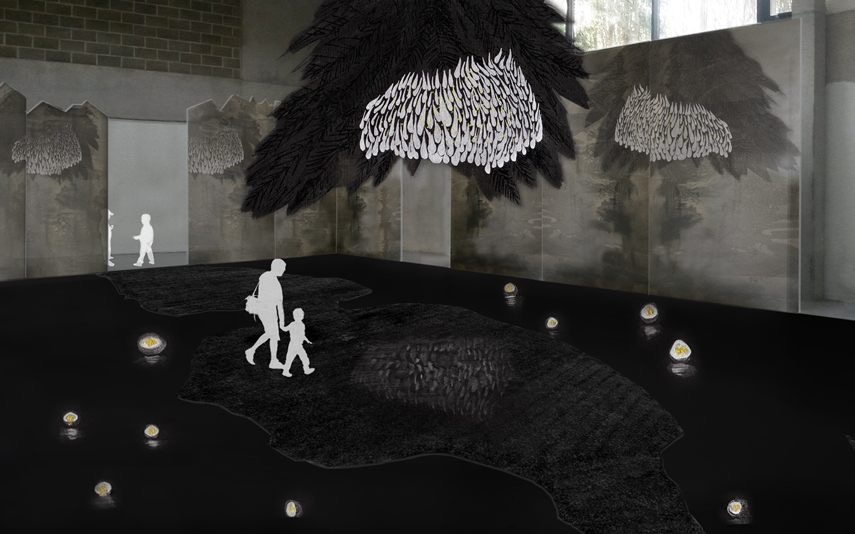
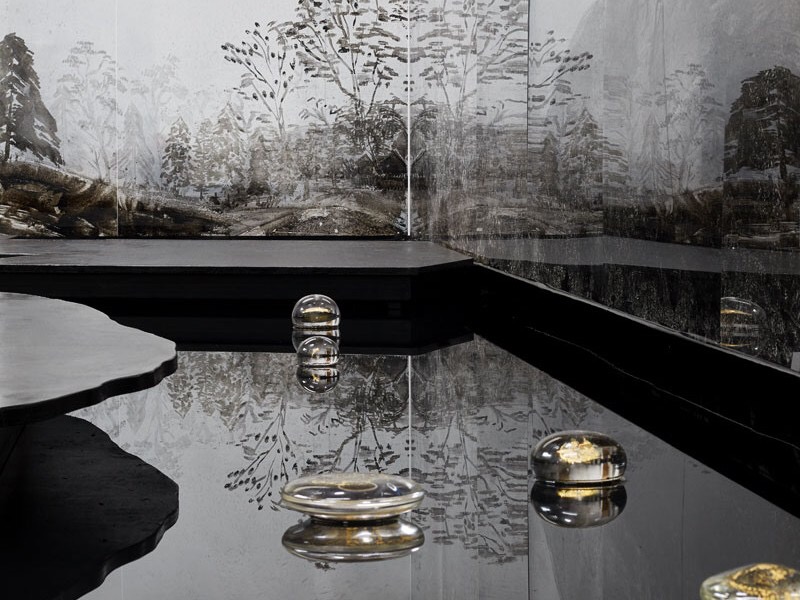
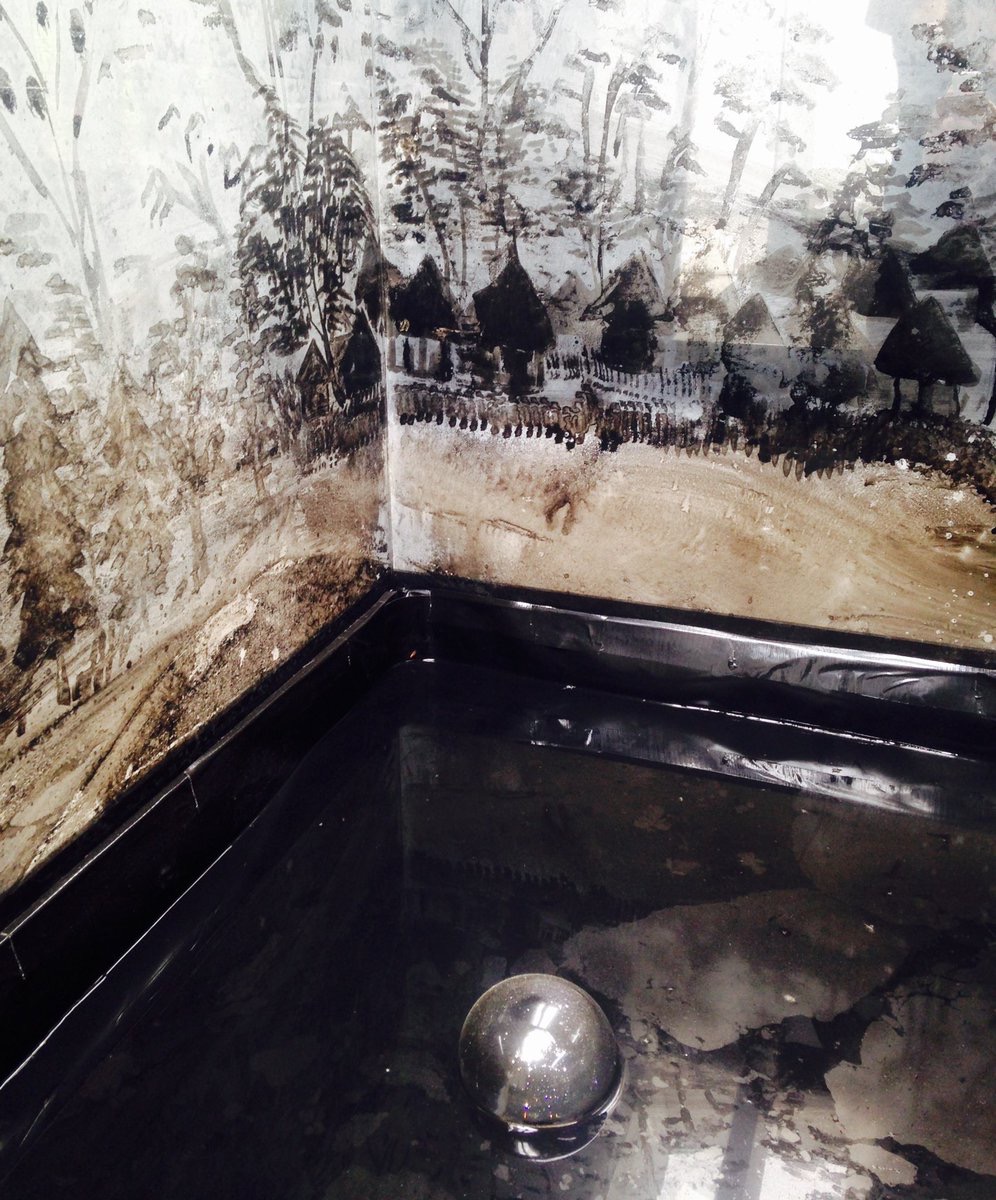
Ink-painted acrylic glass panels, 480 pieces of hand-crafted glass, flashspun nonwoven HDPE fiber leaves, 75 kg of Chinese ink, lights, wooden walkway, steel framework, sound files, and audio playback system.
This new installation for the Cass Sculpture Foundation merges mythological, spiritual, and humanistic notions of Paradise, inspired by the surrounding West Sussex English gardens, to create an otherworldly secret landscape within the main gallery.
Upon entering the gallery, visitors see tall panels of semi-mirrored glass encasing a blackened gardenscape occupying a large portion of the gallery. Openings in the glass panels reveal a reflective black landscape path in a pond of black Chinese ink, speckled with illuminated glass spheres. The form of this landscape is based on Chinese garden designs, drawing parallels between gardens of East and West.
An enormous upside-down tree made from black paper hangs from the ceiling, nestling a large cluster of illuminated glass in teardrop shape, in quantity of hundreds to form a chandelier that measures approximately three-meters in diameter. These precious gems appear to be the fruit put forth by the sprawling tree. Lights emanating from the glass fruit come from various points within the cluster, bouncing from one glass to another. The cluster contains larger sized pieces in the center, skirted with smaller bits that get variably diminutive at the outermost perimeter. This tree chandelier reflects onto the surface of the pathway, ink pool, and mirrored panels, framed by the 16 glass pieces that float in the ink. The glass orbs are in various sizes with gold-flecked centers and lights emanating from within.
The mirrored panels blur the boundaries between the gallery space and the installation, reflecting the installation while also permitting visibility to the space beyond. Viewers are completely immersed within the environment, and are free to walk and explore along the pathway. A simple and sparse music composition echoes within the inkscape through speakers.
Concept
This installation is an extension of my exploration of traditional Chinese ink painting in a contemporary framework. Landscape paintings on scrolls are meant to create a panorama and insert the viewer into the landscape. Chinese landscape paintings synthesize multiple perspectives into a single work, allowing nature to overcome the individual. This idea is interpreted here within a three-dimensional state, as the viewer has an immersive experience within the ink landscape.
Mo, Chinese ink, has been the main medium for expression and communication for centuries in East Asia. It embodies all colors, emulates all forms, gives meaning to brush strokes, and aesthetic achievements. Concurrently, black is the culmination of all colors and absent of all light. It is also a powerful symbol of void and muteness.
This work also meditates on the idea of paradise in historical and contemporary society as a continuation of my last three years of researching mythical gardens – from Babylon to the Garden of Eden Babylon–which led to the development of installation opera Paradise Interrupted.
The word paradise means enclosure or park. Throughout history, humans try to break down the barrier of this utopian idea to get into or out of a paradise. Psychological and emotional paradises must also be grappled with–ideals of how life would be, notions about parents or caregivers, etc. We reconstruct our lives in accordance with new discoveries and persevere.
The capsized tree of life hanging in the middle of the landscape is our broken paradise. Despite its state, it is still generously distilling its essence into the gems. The gems that sparkle in the pond and hang from the tree are shaped like commas, tear drops, sperms, embryos, tumors or perfectly shaped spheres. They are the fruits of inspiration that are borne by the blackened tree of life. The semi-reflective panels surround and protect this magic while reflecting the interior and showing us ourselves, thinly veiling what lies steps beyond its walls.
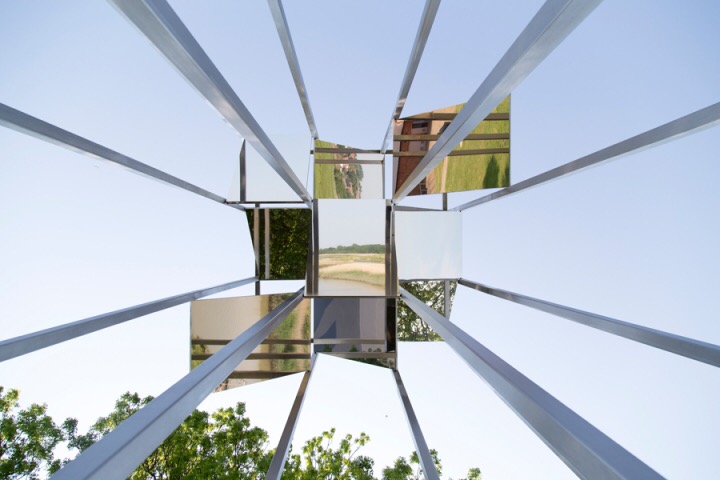
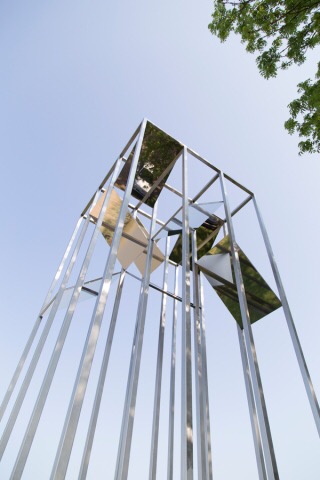
Check out this fabulous sculpture recently erected at Snape Maltings in Suffolk by artist David Rickard and architect Germano Di Chello…

The below text is by Lauren Grieco and was lifted directly from FRAME MAGAZINE.
CORD crafts a multidirectional periscope for children to view distant vistasSUFFOLK – Snape Maltings, an art complex which is also the home of an outdoor sculpture garden, concert hall and the Aldeburgh Festival, sits amid a picturesque landscape along the coast.
To join the noteworthy artworks by Henry Moore, Barbara Hepworth and Sarah Lucas, the Aldeburgh Music and Suffolk Coastal District Council called for a sculpture which ‘offers a vantage point across the marshes at Snape’. Artist David Rickard and architect Germano Di Chello responded with an out-of-the-box solution which reflects its surroundings. Hailing from New Zealand and Britain respectively, the London-based interdisciplinary duo brought together their complementary backgrounds to form Collaborative Office of Research and Design (CORD) in 2011.
Instead of a conventional stairway leading to a platform to overlook the rolling countryside, Rickard and Di Chello let curiousity seekers keep their feet firmly planted on the ground. Stretching skywards from a square footprint, Myriad is a steel tower which reaches nearly nine meters in height. Secured within the metal framework, mirrored and brushed steel panels at its base and zenith of the columns work together to play upon the principle of a periscope. As children and adults gaze into the low-lying mirrors, glimpses of the distant landscape appear.
An old friend of mine, Sam Treadaway, is a British artist, currently living and working in Bristol. His multidisciplinary practice includes: sculpture, book-arts, scent works, and occasional live events. Making use of existing frictions between aesthetic form and utilitarian function, he edits and re-aligns found objects, structures, and systems thus generating new outcomes. The interplay between the arts and other fields of knowledge, such as philosophy and science, often inform these processes – www.samtreadaway.com
For the past few weeks Sam has been resident artist at AirSpace gallery in Stoke-on-Trent and his work can be found there until 23 June.
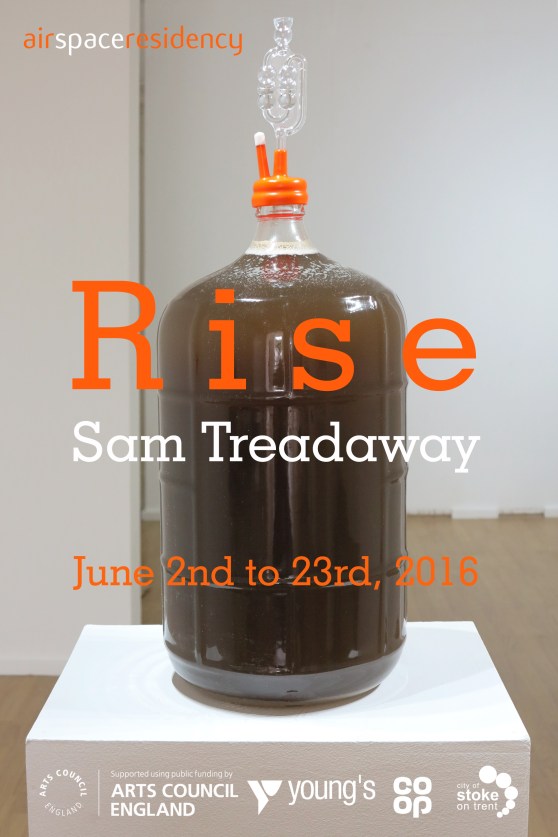
“During my residency project titled, Rise,I have temporarily converted the gallery into a micro-brewery and artisan bakery, to explore the profoundly social role that food plays within society, as a primary source of sharing and as a manifestation of altruism. With a focus on relational activities of exchange and collaboration, and working with locally sourced produce, ten gallons of Mead (honey wine) and over 100 loaves of bread (connected by their key alchemic ingredient of yeast) have been produced at the gallery. Fresh bread has been gifted to gallery visitors each a.m. and the project has included a free participatory bread making workshop (with a mobile wood-fired bread oven) in collaboration with B-Arts (www.b-arts.org.uk).
As my practice as an artist often includes works with scent and the sense of smell, during this project I have been particularly interested to test how the everyday aromas of the raw materials (honey, flour, yeast, and water) and the processes of fermentation and bakery, circulate and are experienced within AirSpace. Parallel to this I have experimented with other methods of diffusing these scents (such as the smell of honey) within the gallery to further my enquiry into the unique ability of smell to simultaneously fill and empty a given space and transcend fixed boundaries.”

Rise will conclude with a ‘Mead-In’ gathering, at AirSpace gallery, on Thursday 23rd of June 2016, from 7–9 pm. This celebratory event will include a Mead tasting and works in progress developed during the residency project.
Rise has received support ‘in kind’ from: AirSpace Gallery; Young’s Home Brew; B-Arts; Shipton Mill, Hillbrook Apiaries; The Co-operative; Stable Cottage Apiaries.
Here’s a review, of Black and White an exhibition by Andrew Dalton at Helmsley Arts Centre, that never made it to print…
Andrew Dalton’s landscape prints look like the strong, callused hands of men that have spent their lives working the land in North Yorkshire, or manipulating steel in Teesside. Black and White by Andrew Dalton at Helmsley Arts Centre is an exhibition of bold, masculine sweeps of pitted black inky prints, of hardworking landscapes.
North Yorkshire born Dalton studied Fine Art Printmaking at London’s Central Saint Martins after which he travelled and worked in the arts for almost 20 years before returning to his home county in 2006 where he has settled with his family in Thirsk. Dalton’s attentions are now focused on his art own art practice and developing a small print workshop in Thirsk.
Black and White is not, however, a Yorkshire Tea box-esque visual translation of a rural idyll; visitors to Helmsley Arts Centre are greeted by two, large, dark, brutal prints that appear to epitomise industrial Middlesbrough. Following them is a series of arresting landscapes possessing a drama that far outweighs their physical scale as merciless skies lay bare the brutality of local weather that beats down on a patchwork of textures that builds the pictorial landscape.
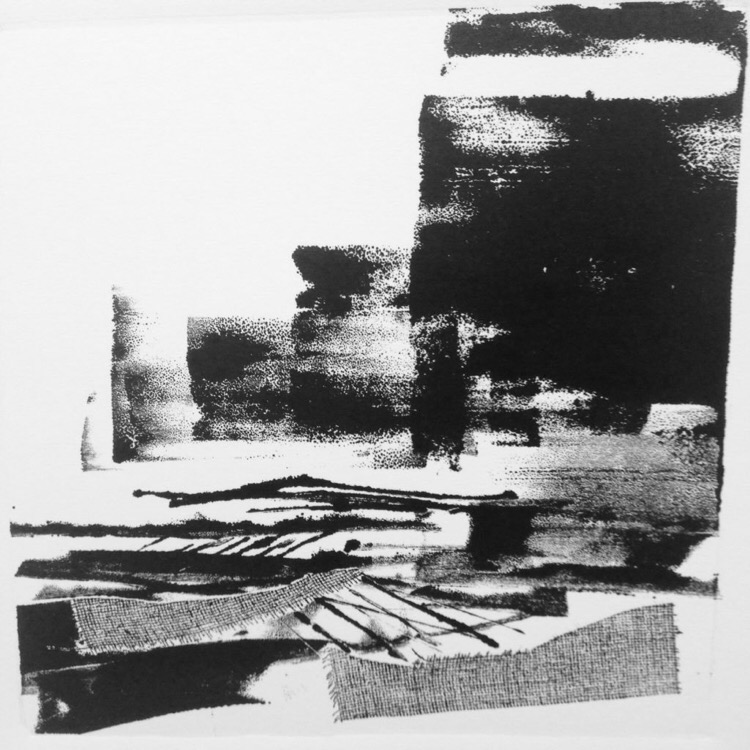
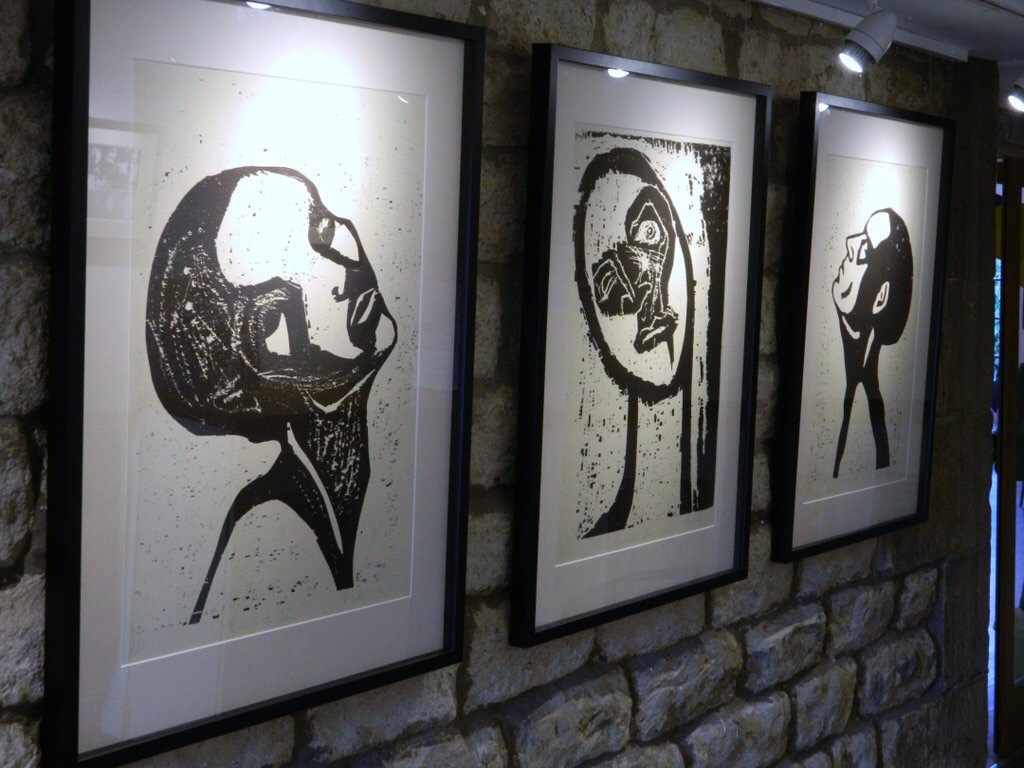
A series of four more abstracted scapes see the introduction of grey into Dalton’s otherwise monochrome palette, whilst skilled draftsmanship and accomplished mark-making can be observed in Dalton’s haunting figures that punctuate the exhibition.
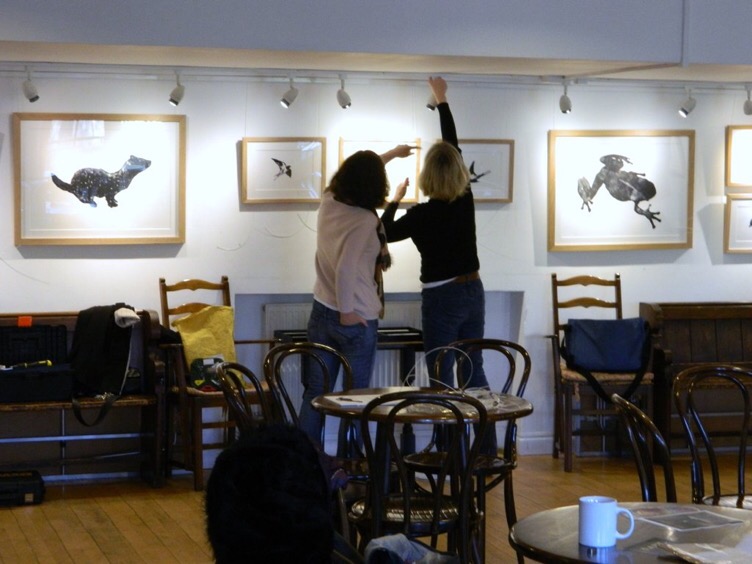
To enter the bar area of the arts centre is to become enveloped in a woodland scene where Dalton’s prints of wild animals dance around the walls.
Commenting on the thread that links the subjects within his practice Dalton explains,
“I try to create images that offer the viewer ambiguous forms to consider and fill with their own meaning.” He continues, “A dragonfly, bird or figure can represent itself or the memory of an event, place or time.”
However accomplished, I have seen sufficient leaping hares to last me a lifetime, it is Dalton’s entrancing landscapes that are the real tour de force in this exhibition – they, to me, are exceptional.
• Black and White by Andrew Dalton was on display at Helmsley Arts Centre, The Old Meeting House, Helmsley, York, YO62 5DW from to 3 May to 3 June 2016.
 Sarah Frances Mayhew